
Investors who held shares in the Bluerock Total Income+ Real Estate
Fund woke up in December 2025 to a changed product. Their interval fund
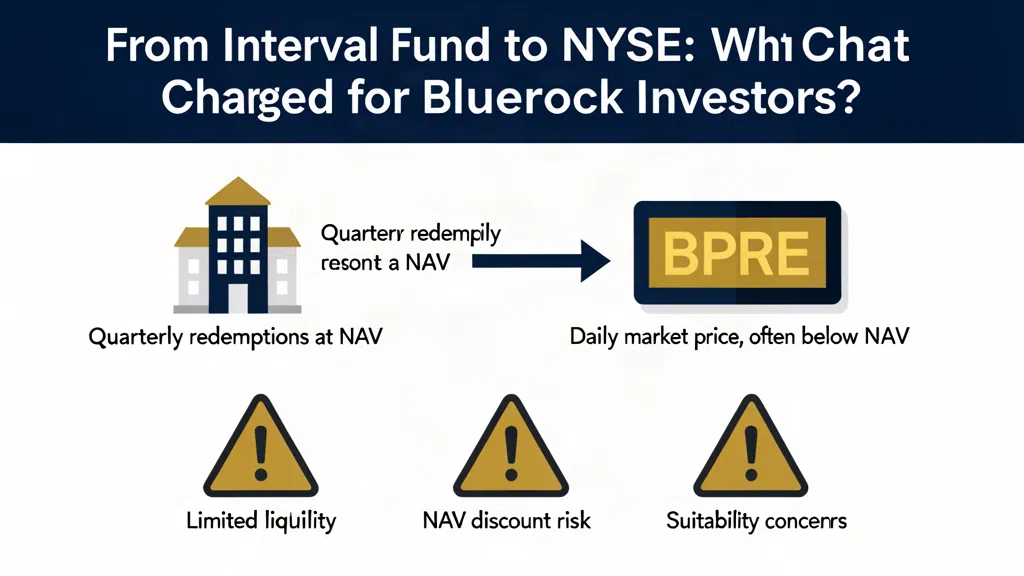
— which had offered quarterly redemptions at net asset value (NAV) —
converted into the Bluerock Private Real Estate Fund (ticker: BPRE), a
publicly traded closed-end fund listed on the New York Stock Exchange
(NYSE). Shares reportedly began trading below the fund’s prior NAV, and
investors who held through the transition saw their holdings decline.
Haselkorn & Thibaut, P.A., operating as Investment Fraud Lawyers, is
investigating whether broker-dealers made unsuitable recommendations or
failed to disclose the material risks of this conversion before selling
the product to retail investors.
What
the Bluerock Total Income+ Real Estate Fund conversion means
Table of Contents
The Bluerock Total Income+ Real Estate Fund conversion restructured a
product that many investors bought for its quarterly redemption feature.
An interval fund is a type of investment company registered under the
Investment Company Act of 1940 that permits share repurchases only at
designated intervals and only in limited amounts. The Securities and
Exchange Commission (SEC) regulates interval funds as registered
investment companies, but their liquidity structure differs
substantially from open-end mutual funds.
Before the conversion, investors could redeem shares during quarterly
repurchase offers at NAV-based prices. The fund was not required to
honor all requests, but the pricing gave shareholders a predictable exit
value tied to the underlying assets.
After the conversion, BPRE shares trade daily on the NYSE at prices
determined by supply and demand. Closed-end funds frequently trade at a
discount to NAV due to limited demand, distribution changes, and
investor uncertainty. For former interval fund shareholders, that
discount represents a real, immediate loss that did not exist under the
prior structure.
| Feature | Before conversion (interval fund) | After conversion (closed-end fund) |
|---|---|---|
| Structure | Bluerock Total Income+ Real Estate Fund | Bluerock Private Real Estate Fund (BPRE) |
| Pricing | NAV-based, determined quarterly | Market-determined on NYSE, often below NAV |
| Liquidity | Quarterly repurchase offers at NAV | Daily trading on NYSE at market price |
| Redemption guarantee | Fund repurchases up to 5% of shares quarterly | No redemption guarantee; sell on exchange |
| Investor control | Limited but predictable exit at NAV | No control over discount to NAV |
| Distribution risk | Managed by fund board | Market-dependent; discount may widen |
Why the
conversion raises suitability questions
The Financial Industry Regulatory Authority, or FINRA, requires
broker-dealers to conduct reasonable due diligence on the products they
recommend and to ensure that each recommendation is suitable for the
specific customer. FINRA Rule 2111 imposes three suitability
obligations: reasonable-basis suitability, customer-specific
suitability, and quantitative suitability.
When the Bluerock Total Income+ Real Estate Fund was sold as an
interval fund, brokers marketed periodic income and quarterly redemption
access as key features. The conversion to BPRE eliminated both.
Investors who relied on NAV-based redemptions for retirement income or
capital access now face a product whose market price may not reflect the
value of the underlying real estate portfolio.
Common suitability failures we see in BPRE cases include recommending
the product without analyzing NAV discount risk, selling BPRE to
retirees who needed income stability, and over-concentrating portfolios
in a single illiquid fund. For a broader discussion of broker-dealer
obligations in Bluerock cases, see our
Bluerock
real estate losses resource page.
What investors should do now
Investors who held Bluerock Total Income+ Real Estate Fund shares and
experienced losses following the conversion to BPRE should take several
steps. Review your account statements and trade confirmations to
document the NAV at which you originally purchased shares and the market
price at which BPRE began trading. Gather the offering documents and any
marketing materials your broker provided. Document your investment
profile at the time of purchase, including age, income, net worth, risk
tolerance, and liquidity needs.
Our attorneys include former Wall Street defense counsel who
understand how firms vet these products — and where that vetting falls
short. For a detailed analysis of the BPRE conversion and broker-dealer
liability, see our
Bluerock
Private Real Estate Fund (BPRE) losses page.
How Investment Fraud
Lawyers can help
We offer free consultations for investors who sustained losses in
BPRE or the former Bluerock Total Income+ Real Estate Fund. Our firm
works on a contingency fee basis: there is no recovery, no fee. We
pursue claims through FINRA arbitration and civil litigation, focusing
on unsuitable recommendations, inadequate disclosure of conversion
risks, and broker-dealer due diligence failures.
Call 1-888-885-7162 or visit InvestmentFraudLawyers.com to schedule a
confidential consultation.
Disclaimer: Past results do not guarantee future outcomes. This
article provides general information and is not legal advice. No
attorney-client relationship is formed by reading this content. There is
no guaranteed recovery in any securities matter. Consult a qualified
attorney regarding your specific situation.